
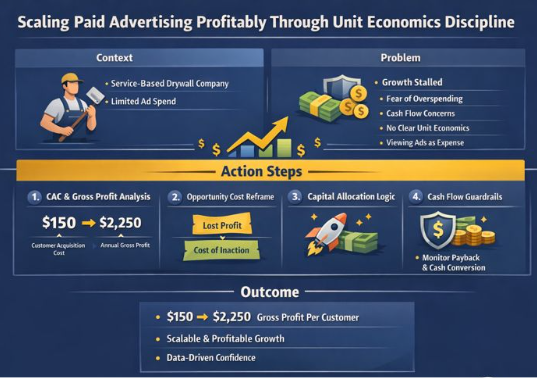
Context
A service based drywall company had an existing paid advertising channel that was functional and producing customers. Initial results were positive, but ad spend remained intentionally limited.
Leadership operated in a capital constrained mindset common to service businesses, where preserving cash often feels safer than reinvesting aggressively—even when returns appear favorable.
Problem
Despite early success, growth stalled due to risk aversion, not market conditions.
Key challenges included:
- Fear of scaling advertising spend without “absolute certainty”
- Concern that increased spend could strain cash flow
- Lack of a clearly articulated unit economics model to support decision making
- Treating marketing spend as an expense rather than an investment
The core issue was not marketing performance—it was decision confidence.
Action Taken (Strategic Doctrine Applied)
Leadership reframed the decision using first principles unit economics instead of intuition.
1. CAC and Gross Profit Analysis
- Calculated that each customer cost approximately $150 to acquire (CAC).
- Analyzed downstream economics and found each customer generated approximately $2,250 in annual gross profit.
- Established a clear relationship between marketing input and financial output.
2. Risk Reframed as Opportunity Cost
- Demonstrated that not scaling ads was the greater financial risk.
- Quantified lost profit resulting from under investment in a proven channel.
- Shifted thinking from “protecting cash” to “deploying capital where returns are asymmetric.”
3. Capital Allocation Logic
- Treated paid advertising as a repeatable profit engine, not a variable cost.
- Advocated for reinvesting aggressively into the channel while unit economics remained favorable.
- Ensured that increased spend was governed by continued CAC monitoring, not blind scaling.
4. Cash Flow Guardrails
- Emphasized disciplined tracking of payback period and cash conversion.
- Framed ad spend increases as reversible and data governed, not permanent commitments.
Outcome
The analysis demonstrated a clear and defensible path to profit growth:
- Each incremental $150 invested in ads reliably produced ~$2,250 in annual gross profit.
- Scaling spend directly translated into increased contribution margin.
- The business could grow profitably by reinvesting cash into a channel with proven economics.
The result was not just higher marketing confidence, but institutional clarity around capital deployment.
Why This Case Matters
This case highlights a core GM-level insight:
In service businesses, growth stalls not from lack of opportunity—but from failure to trust proven unit economics.
By grounding decisions in CAC, LTV, and gross profit contribution, leadership replaced fear-based restraint with controlled, data-backed aggression. This is how small service businesses transition into scalable, cash-generative operations
