
Context
A $10M annual revenue service business generating approximately $2M in profit faced a hard growth ceiling. Market demand for services significantly exceeded delivery capacity, and leadership had high confidence that demand was effectively “unlimited” at current pricing.
The company employed 38 skilled service providers, each requiring meaningful onboarding and quality control. Growth was no longer constrained by marketing, pricing, or sales—it was constrained by labor supply.
Problem
The company’s primary constraint was operational, not commercial:
- Revenue growth was capped by the number of qualified service providers available
- Internal recruiting capacity was too slow to meet demand
- Traditional hiring approaches risked:
- Bringing on non performers
- Degrading service quality
- Increasing churn and rework
- Leadership faced a tradeoff between speed and quality, both of which were non negotiable
The core question became:
How do you remove a labor bottleneck fast without destroying margins or standards?
Action Taken (Strategic Doctrine Applied)
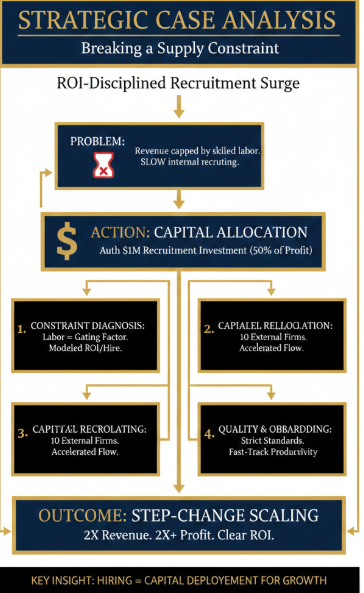
Leadership designed a recruitment surge initiative, treating hiring as a capital allocation decision, not an HR activity.
1. Constraint First Diagnosis
- Identified skilled labor as the single gating factor to revenue growth.
- Confirmed that additional demand could be fulfilled immediately if capacity increased.
- Modeled revenue and profit upside per incremental hire.
2. Capital Reallocation Toward the Constraint
- Authorized a $1M recruitment investment, representing 50% of annual profit.
- Framed the spend explicitly as a growth investment, not overhead.
- Evaluated success based on ROI, not cost minimization.
3. Parallelized Recruiting via External Firms
- Engaged 10 external recruiters simultaneously to massively increase candidate flow.
- Avoided the time lag of scaling an internal recruiting team.
- Created parallel pipelines to compress time to hire.
4. Quality and Onboarding Risk Management
- Maintained strict performance standards to mitigate the risk of rapid hiring.
- Structured onboarding to bring new hires to productivity quickly without sacrificing quality.
- Treated onboarding speed as a controllable operational variable.
5. ROI Driven Hiring Model
- Modeled the economics such that:
- Incremental labor unlocked immediate revenue
- Marginal profit from new capacity exceeded recruiting costs
- Structured the initiative so that payback was clear and defensible.
Outcome
The recruitment surge was explicitly structured to:
- Remove the primary growth constraint
- Double revenue by expanding service delivery capacity
- More than double annual profit, as fixed costs were already covered
- Generate a clear, measurable ROI on the $1M recruiting investment
The initiative reframed recruiting from a support function into a core growth lever.
Why This Case Matters
This case demonstrates a critical GM level insight:
When demand is proven, hiring is not an HR problem—it is a capital deployment decision.
Instead of incrementally optimizing recruiting costs, leadership optimized for constraint removal speed, while preserving quality and unit economics. This is the difference between slow, linear growth and step change scaling.
