
Context
A $4M residential window replacement company relied on a door to door (D2D) sales model using a classic setter–closer structure.
The business operated in a notoriously high churn sales environment, where rapid turnover is often treated as unavoidable. Growth targets required scaling the sales force, but leadership faced mounting concerns about sustainability, morale, and performance consistency.
Problem
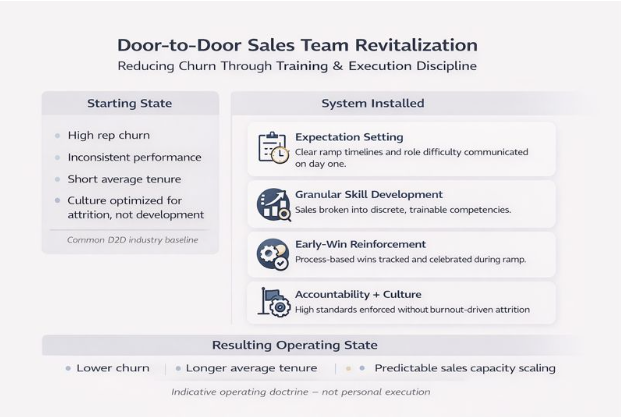
The sales organization suffered from three compounding issues:
- High rep churn, leading to constant hiring and training cycles
- Inconsistent performance, with large variance between top and bottom reps
- Cultural erosion, as pressure to produce conflicted with the need to retain talent
Industry norms accepted attrition as the cost of doing business. However, this approach created hidden drag on growth by inflating recruiting costs, reducing average rep tenure, and preventing predictable scaling.
The core issue was not lead flow or comp plans—it was how reps were onboarded, developed, and supported.
Action Taken (Strategic Doctrine Applied)
A revised sales training and onboarding system was implemented, designed to treat D2D sales as a developable profession, not a trial by fire filter.
1. Expectation Setting from Day One
- Reframed the role with explicit clarity around difficulty, rejection rates, and ramp timelines.
- Removed ambiguity that often causes early stage burnout and misaligned expectations.
- Positioned success as a function of skill acquisition, not raw grit alone.
2. Granular Skill Decomposition
- Broke D2D sales into discrete, trainable competencies (approach, opener, objection handling, handoff).
- Focused coaching on specific behaviors rather than generic “sell harder” feedback.
- Enabled targeted improvement instead of overwhelming new reps.
3. Early Win Reinforcement System
- Introduced mechanisms to celebrate small, process based wins (doors knocked, conversations held, scripts executed correctly).
- Shifted early motivation away from commission dependency toward momentum and mastery.
- Increased rep confidence during the most fragile phase of tenure.
4. Culture Without Lowering Standards
- Maintained performance accountability while removing unnecessary psychological attrition.
- Built a training environment that was demanding but not adversarial.
- Reinforced that the company invested in reps who invested in skill development.
Outcome
While exact metrics were not publicly disclosed, the strategy was explicitly designed to:
- Reduce sales rep churn by increasing early stage survivability
- Improve average rep performance through structured skill development
- Increase tenure and consistency, lowering the hidden cost of constant replacement
- Enable sustainable scaling of the D2D sales force without cultural collapse
The result was a sales organization that could grow capacity without relying on burnout as a hiring filter.
Why This Case Matters
This case highlights a critical operator insight:
In high churn sales environments, retention is not a “people problem”—it is a systems problem.
Rather than accepting industry norms, leadership treated onboarding, training, and motivation as controllable execution levers. This reframing allows sales driven businesses to scale with lower volatility, lower cost, and higher predictability.
