
Context
A publicly traded company with approximately $200M in annual revenue operating under the constraints of public market scrutiny, investor expectations, and quarterly performance pressure.
The organization sought aggressive growth in both revenue and market capitalization, while maintaining credibility with analysts, shareholders, and regulators. Unlike private companies, the business could not rely on short term tactics or founder heroics—growth needed to be repeatable, explainable, and defensible.
Problem
The company faced a common but high risk public market challenge:
- Growth ambitions significantly exceeded the capacity of existing operating systems.
- Revenue expansion had to be sustainable, not artificially inflated through one time levers.
- Any misstep risked loss of investor confidence, valuation compression, or regulatory scrutiny.
- Scaling too fast without discipline could permanently damage margins, execution reliability, or brand trust.
In short, the company needed to multiply revenue without destabilizing the enterprise.
Action Taken (Strategic Doctrine Applied)
A multi year growth strategy was executed with a clear emphasis on core business drivers and operating discipline, rather than speculative expansion.
Key strategic moves included:
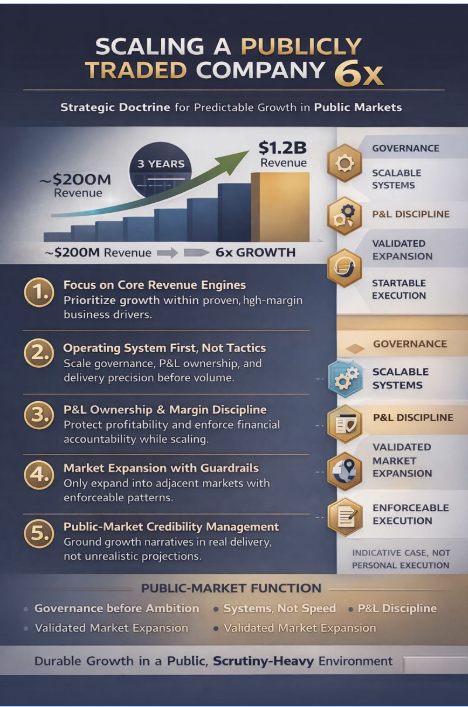
1. Focus on Core Revenue Engines
- Identified and doubled down on the primary revenue drivers already working at scale.
- Avoided distraction from non core initiatives that diluted leadership attention or operational focus.
- Ensured growth efforts aligned with existing customer demand and proven unit economics.
2. Operating System First, Not Tactics
- Growth was gated by the company’s ability to execute predictably across sales, delivery, and support.
- Systems, processes, and accountability structures were reinforced before accelerating volume.
- Management treated scalability as an operational constraint, not a marketing problem.
3. P&L Ownership and Margin Discipline
- Expansion decisions were evaluated through a P&L lens, not vanity metrics.
- Margin integrity and cost structure were protected as revenue scaled.
- Leadership resisted the temptation to “buy growth” at the expense of long term profitability.
4. Market Expansion with Guardrails
- Geographic and market expansion followed repeatable patterns, not bespoke plays.
- Each expansion initiative was validated against clear performance benchmarks before replication.
- Capital allocation decisions were staged to reduce downside risk.
5. Public Market Credibility Management
- Growth narratives were supported by real operating results, not forward looking hype.
- Execution consistency reinforced analyst confidence and sustained valuation expansion.
Outcome
- Annual revenue increased from approximately $200M to $1.2B in under three years.
- Represented a 6× revenue increase while operating as a publicly traded entity.
- Growth was achieved without a corresponding collapse in operational stability or credibility.
- The company transitioned from mid scale public operator to category dominant market leader.
Why This Case Matters
This case demonstrates what real scale looks like in a public market environment:
- Growth constrained by governance, not ambition
- Systems before speed
- P&L discipline over vanity metrics
- Market expansion only when execution is enforceable
For boards, PE firms, and executive recruiters, this is the difference between headline growth and durable enterprise value creation.
