
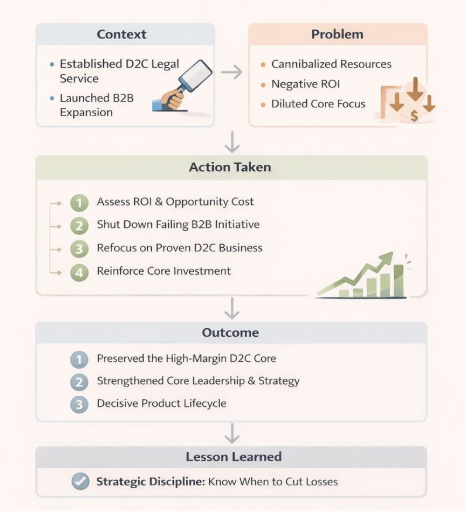
Context
LegalZoom, a well known consumer facing legal services company, built a highly profitable direct to consumer (D2C) business by standardizing access to legal documents and services at scale.
Seeking incremental growth, the company launched a new B2B platform aimed at serving business customers. The initiative represented an expansion beyond LegalZoom’s historical consumer core into a more complex, enterprise oriented market.
Problem
While strategically logical on paper, the B2B initiative created unintended consequences:
- The new platform cannibalized leadership attention, capital, and engineering resources
- B2B customer needs diverged meaningfully from LegalZoom’s proven D2C operating model
- The initiative produced negative ROI, with slower adoption and weaker economics than expected
- Continued investment risked diluting focus and damaging the high performing consumer business
The organization faced a classic portfolio management dilemma:
Should leadership continue investing in a struggling adjacency—or decisively refocus on the proven core?
Action Taken (Strategic Doctrine Applied)
LegalZoom made a deliberate and disciplined strategic retreat, prioritizing enterprise health over sunk cost bias.
1. Clear ROI and Opportunity Cost Assessment
- Evaluated the B2B platform’s financial performance relative to the core D2C business.
- Assessed not just losses, but opportunity cost what core initiatives were being underfunded.
- Recognized that marginal returns in the core far exceeded potential upside of the new platform.
2. Strategic Focus Over Optionality
- Rejected the temptation to “keep options open” at the expense of execution quality.
- Acknowledged that spreading resources across divergent business models weakened both.
- Prioritized depth and dominance in the core over breadth of offerings.
3. Decisive Product Lifecycle Management
- Shut down the B2B initiative rather than allowing it to linger as a distraction.
- Reallocated talent, capital, and leadership focus back to the consumer facing business.
- Treated the shutdown as a strategic correction, not a failure to be hidden.
4. Reinforcement of Core Growth Engine
- Refocused product, marketing, and operational investment on the D2C platform.
- Strengthened the systems and advantages that made LegalZoom successful in the first place.
Outcome
- Eliminated a negative-ROI initiative before it caused lasting damage.
- Restored organizational focus on the high growth, high-margin consumer business.
- Preserved capital and leadership bandwidth for initiatives with proven returns.
- Converted the experience into a durable strategic lesson rather than an ongoing drag.
The decision reinforced that restraint can be as value-creating as expansion.
Why This Case Matters
This case highlights a critical executive insight:
Strategic discipline is not about launching new bets—it’s about knowing when to kill them.
Many organizations allow underperforming initiatives to persist due to sunk costs, optics, or fear of admitting missteps. LegalZoom’s decision demonstrated P&L maturity, portfolio discipline, and respect for the economics of focus.
For GMs, COOs, and strategy leaders, this is a textbook example of protecting the core before extending the frontier
